Wednesday, March 18. 2009
School nightmares

From xkcd #557:
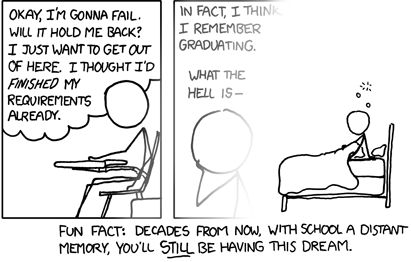
FULL ACK! 
In the first years after my school graduation, already attending university, those dreams developed the situation that graduates are compelled to revisit school for one month every year to refresh a basic knowledge in various subjects—a not too weird idea after all. I went through situations like not remembering the location of our class room, teachers being upset about me not having shown up for long, or having hopelessly missed several exams. Through the years those dreams had to cope with my consciously strengthened memory about my school graduation and about that such a revisiting month simply doesn’t exist. However, a geeky brain like mine is still able to form a new plot.
I think I got rid of those dreams with my university graduation, having settled the idea of not having to attend unpleasant exams ever again. But I probably enjoy being a science/math/computer nerd way too much and should deal more with average daily knowledge about politics, economy, society and culture.
A reason why those dreams come up at all might be that stress and pressure at school are much more formative than they will later be in real working life.
Sunday, March 15. 2009
Macht mich das rasend?
Ich habe einen alten Forenbeitrag von mir aus dem Jahr 2002 ausgegraben, den ich aus aktuellem Anlass sogar unverändert wiedergeben kann:
es ist zwar nicht mehr allzu aktuell, aber ein anderes aktuelles ereignis motiviert mich, doch noch ein politisches kommentar abzugeben.
es geht um die bösheit der computerspiele.
ein “experte” hat unlängst im willkommen österreich (bin zufällig darübergezappt) einen grund für jenes autowettrennen mit tödlichem ausgang darin gesehen, daß einen einschlägige computerspiele auf schnelligkeit und rasertum trimmen würden. nicht beachtet hat er allerdings, daß der orf regelmäßig die formel 1 überträgt, und daß gerade dieser tage das gti/proleten-treffen am wörthersee als volksfest mit positiver wirtschaftlicher auswirkung breitgetreten wird. der witz ist, daß im selben sender, wo sowas übertragen wird, die begeisterung für schnelle autos auf die bösen games abgeschoben wird.
kurz erwähnt seien auch die ego-shooter-spiele, die sich auch in teilen unseres vereins großer beliebtheit erfreuen (mich eingeschlossen): ist es denn nicht unrealistisch genug, daß ausgerechnet die handhabung der waffen an sich (aufnehmen, laden, magazinwechsel) automatisiert abläuft? wie soll ich da im umgang mit waffen geschult werden? und wie soll ich zu einem killer mutieren, wenn sich die teilnehmer totlachen, nach einem tod der eigenen spielfigur fröhlich rache bekunden und sich dabei chips reinstopfen? es handelt sich ja doch nur um ein spiel wie jedes andere.
warum wird denn bei autorennspielen oder flugsimulatoren so viel wert auf realismus gelegt? weil die atmosphäre dann viel mehr spaß abwirft. auch ich stehe auf die autocrashs in zeitlupe in diversen tv-serien. für wen sind denn verfolgungsjagden - das action-element schlechthin - kein nervenkitzel? da schmecken doch chips und popcorn gleich viel besser! deswegen komme ich aber doch nicht auf die idee, mich selbst in irgendwas zu stürzen.
was ich damit sagen will: das angebot an unterhaltung derart macht noch keinen verrückten. man muß auch logisch bleiben: nur weil es durchdreher gibt, die sich an sowas ergötzen, heißt das noch nicht, daß alle actionfilm-schauer und ballerspieler potentiell gefährdet sind. mit anderen worten: es gibt wein, und es gibt eben weinliebhaber, aber leider auch alkoholiker. solange es menschen gibt, wird es leider auch verrückte geben, die ihre umwelt nicht verarbeiten können.
Und auf die aktuelle Amoklauf-Diskussion bezogen: Klar spielt auch ein psychisch gestörter Waffennarr gerne Ballerspiele. Das ist aber Wirkung, nicht Ursache. Amokschützen gab es doch schon vor zig Jahrzehnten. Für gesunde, ausgewogene Psychen sind actionreicher Sport, Spiel, Filme und Games einfach eine Möglichkeit sich auszugleichen, abzureagieren. Wenn politisch Aktive lieber die Unterhaltungsmöglichkeiten für alle Bevölkerungsschichten einschränken, liegt dies wohl eher an Macht- und Kontrollsucht und einer starken Waffenlobby. Das ist ein Grund zum Fürchten!
Im übrigen ist es wohl eher die schlechte Kombination von hohem Testosteronspiegel und angeschlagener Psyche, die in Aggression, Raserei, Gewalt, Krieg, usw. mündet. Dummerweise führt genau das aber auch zu führenden politischen Ämtern.
Friday, March 13. 2009
Free software vs. Microsoft
Wednesday, March 11. 2009
Freedom and confinement now over
It was exactly three years ago when I sold my previous car. The months before that sale were such a torture and the sale itself was such a relief that I decided to go on without an automobile for some time. I had been living in a vicious circle: I rarely used the car as it was always broken, and it was always broken as I only used it rarely and had it parked outside in all weathers. And because I actually only needed it rarely in the big city, it wasn’t that hard living without one. However, it really would have been impossible without Doris’ company car that enabled a casual weekend shopping or similar. But furnishing our new home outside the urban area was unthinkable with that small vehicle, what forced us to borrow a car from our families once in a while.
Our demands have changed and the torture is now exactly on the immobile side, what led us to the acquisition of a more spacious vehicle. We broke it down to a Škoda Fabia station wagon, as the Octavia model provides more space than we really need. Although a certain Austrian cabaret artist makes fun of people who buy a Škoda with extra equipment (i.e. those who want to have everything but don’t want to pay for it), we just became such folks. It’ll be a Fabia II Combi Elegance 1.6 with 77 kW in Flamenco red Anthracite gray and will arrive at the beginning of May. The list price was just under €20,000.
Thursday, March 5. 2009
What a speed gain!

I complained about my old notebook being too slow at image processing. As I now run a new machine, it’s time to measure the performance increase:
Old system: 1×1.6 GHz CPU, 1 GB RAM
New system: 8×2.67 GHz CPU (by threads), 6 GB RAM
Test file sizes: 11.2–12.5 MB
Task #1: Render 8 RAW images to PPM in multi-parallel
Command line:
time dcraw $file &
done
Old system time: 1 min 41.1 sec
Old system mem usage: 1 GB (100%)
New system time: 0 min 04.6 sec
New system mem usage: 2 GB (33%)
→ 22× faster
Task #2: Render 8 RAW images to JPEG in multi-parallel
Command line:
time convert $file $(basename $file .cr2).jpg &
done
Old system time: 5 min 0.0 sec
Old system mem usage: 1 GB (100%)
New system time: 0 min 18.2 sec
New system mem usage: 2.5 GB (42%)
→ 16.5× faster
Hell yeah! 
Tuesday, March 3. 2009
Gathering Core i7 temperatures with Linux

Debian’s standard kernel 2.6.26 has a little drawback: The coretemp module doesn’t recognize Intel’s Core i7 processor. The sensor chip W83667HG of my Asus P6T Deluxe (LGA 1366 socket) is not yet supported as well. This is a typical symptom when using Linux on too recent hardware. However, if it’s enough for you to read an aggregated CPU temperature instead of eight individual core temperatures, you can force loading the w83627ehf module with
and tune the /etc/sensors3.conf to get rid of false alarms.
Luckily, for the current prerelease 2.6.29-rc6 there’s a very recent bunch of patches available that brings support for W83667HG into the w83627ehf module, whereas coretemp already finds the CPU. Follow this guide on how to compile and install a new kernel the Debian way. A drawback is that source modules from the official Debian repositories might not compile anymore, e.g. the MadWifi modules. You have to get them from the project directly (via SVN). You also need to build a current version of lm-sensors (via SVN) to correctly gather the values from w83627ehf. You could then visualize the values e.g. with gkrellm.
Now have fun stress-testing your system with MPrime.
Update 03/24: It appears that these patches didn’t make it into the final 2.6.29 release. 
Update 04/09: The patches went into 2.6.30-rc1.
Sunday, March 1. 2009
Configuring Bluetooth on Linux 5ucks!
Because it’s a pain, a short reminder for myself on how to connect a Bluetooth capable cell phone with a Debian box:
- Install bluez-utils.
- Read this (German) guide and follow instructions, but ignore the obsolete stuff about the pin helper; today it’s just an entry like passkey “1337”;
- For whatever reason, hcid doesn’t launch a passkey-agent automatically. For the very first connection, you have to do it by yourself:
- Get both the passkey-agent.c.gz source and its Makefile from the bluez-utils examples directory and compile it; you’ll need libdbus-1-dev.
- Launch it as /path/to/passkey-agent 1337 HA:RD:WA:RE:AD:DR and go to a different shell.
- cat < /dev/rfcomm0 and enter the requested pin on your cell. If nothing special happens, you’re done.
In your cell’s Bluetooth settings you could now permanently authorize your PC. The next cat < /dev/rfcomm0 shouldn’t initiate a pin request anymore.
Friday, February 27. 2009
‘davinci’ up and running (like hell)
Two days ago I finished assembling my new workstation and set up a 64-bit Debian ‘lenny’ on it. When I decided to go for Intel Core i7 I wasn’t aware that due to Intel’s Hyperthreading technology each of the four cores is able to handle two threads at once, making it effectively an eight(!)-core system to the OS! Dig this:
I thought that the onboard Intel SATA-RAID controller provided a hardware RAID, but it’s just a software RAID in disguise, so I can well let Linux do the job. Then I had problems setting up WLAN with the Atheros card I built in, but thanks to the MadWifi project I got it running. What else? Yes, Memtest86 v3.5 didn’t boot on Core i7 and/or 6 GB RAM, but Memtest86+ v2.11 did.
I named the new system ‘davinci’, honoring the technological genius Leonardo da Vinci, what is consistent with the weapon-like appearance of the Cooler Master Storm Sniper case. 
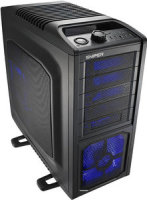
I proudly list the installed components here:
- CPU: Intel Core i7-920 4×2.67GHz
- RAM: OCZ Platinum 3×2GB DDR3-1600 SDRAM, CL7-7-7-24
- Mainboard: Asus P6T Deluxe, 6×DDR3-1333 slots
- GPU: Zotac GeForce GTX 260 AMP²! Edition, 896MB GDDR3, PCIe 2.0 ×16, 2×DVI
- Harddisks: 2× Western Digital RE3 1TB SATA II, RAID-1
- Optical drive: LG Electronics GH22LS30 SATA, 22×/8×/12× DVD±R/+RW/-RAM
- WLAN: D-Link AirPlusXtremeG DWL-G520, 108Mbit, PCI
- Case: Cooler Master CM Storm Sniper
- Power supply: Cooler Master Silent Pro 700W
- Monitor: Samsung SyncMaster 2693HM 26″ TFT-LCD, 1920×1200, DVI, HDMI, speakers, USB
- Input devices: Logitech Cordless Desktop Wave
Currently I just use Intel’s boxed CPU cooler, so I haven’t done any overclocking yet. I’m having an eye on the Cooler Master V10 that’ll be available by April. With this I aim to overclock the cores to 3.2 GHz for the first time, what I might increase to a maximum of 3.8 GHz one day.
Calendar

|
September '26 |

|
||||
| Mon | Tue | Wed | Thu | Fri | Sat | Sun |
| 1 | 2 | 3 | 4 | 5 | 6 | |
| 7 | 8 | 9 | 10 | 11 | 12 | 13 |
| 14 | 15 | 16 | 17 | 18 | 19 | 20 |
| 21 | 22 | 23 | 24 | 25 | 26 | 27 |
| 28 | 29 | 30 | ||||
Quicksearch
Archives
Categories

Show tagged entries
Follow me





