Thursday, December 7. 2006
Tätigkeitsbereiche

Beschäftigungszeitraum: 10.07.2003 - 31.01.2007.
Alle Aufgabenbereiche wurden in direktem Kontakt mit dem jew. Kunden abgewickelt.
Lotus-Notes-Development
- Ab 2004/06: S. S. AG: Einführung eines DMS unter Analyse und Abbildung der Kundenworkflows. Umsetzung umfangreicher Anpassungen und Erweiterungen. Implementation und Integration einer Artikel- und einer Projektverwaltung. Erweiterung des Helpdesksystems. Projektaufwandsanteil >110MT.
- Ab 2005/04: Implementation und ständige Weiterentwicklung des hauseigenen Produkts “Visual Team Calendar” in Kooperation mit der AdHoc, s.r.o. (Prag, CZ). Anpassungen für C. Z. GmbH (Geräteverleih), A. A. und A. A. GmbH.
- 2004, 2006: E. Reiseversicherungen: Implementation einer automatisierten Verarbeitung von Attachments eingehender Mails, Sortierung nach konfigurierbaren Kriterien, Datenextraktion. Erweiterung um FTP-Transfer.
- A. A. GmbH: Übernahme der Betreuung des DMS. Migration des angepassten DMS auf neue Version. Implementation und Integration einer Verkaufsunterlagen-Verwaltung.
- Teilhabe an der Hauptverantwortung für den Betrieb des Webhostings, verteilt auf 4 IBM-Rechner: DNS von über 150 Domains, ca. 140 Webauftritte, ca. 330 User, Mailserver mit Virus- und SPAM-Filter, J2EE-basierendes CMS, Lotus-Domino-Hosting.
- Installation und Erweiterung eines Überwachungssystems inkl. differenzierter Alarmierung bei Ausfällen.
- Migration (Konsolidierung) von PostgreSQL auf MySQL.
- Wartung der firmeninternen Systeme. Kundenprojekte:
- A. A. GmbH: Selbstständige Vorbereitung und Abhaltung einer fünftägigen Linux-Schulung für 4 Personen.
- F. H. GmbH: Wartung und Erweiterung des Mailservers durch SPAM-Filter.
- R. F. GmbH: Systemmigration auf RAID-Festplattenverbund, Backup-Implementation mit Transfer auf IBM AS/400-Rechner.
- Dr. K. & M. GmbH: Systemmigration auf RAID-Festplattenverbund, Lotus Domino Backup-Szenario.
- S. S. AG: Migration eines J2EE-basierenden CMS inkl. Webauftritt von Suse Linux auf Debian GNU/Linux.
- M. Handelsges.m.b.H., G. & H. OEG: Migration eines Windows-Fileservers auf Linux/Samba.
- 2003: Wartung, Betreuung und Erweiterung des Immobilienportals FMH (G. & H. OEG) in PHP/MySQL, z.B. Erweiterung der Suchfunktion.
- 2004/03-2005/03: Wartung, Betreuung und Erweiterung des Hotelportals H4Y (E. Verlagsges.m.b.H.) in PHP/MySQL und tw. JavaScript/DOM, z.B. Mehrsprachigkeit, Mitgliederbereich, Newsletterkampagnen, Veränderung der Reihung und Hervorhebung von Suchergebnissen, Erweiterung des CMS, Bannerverwaltung, Bannerrotation.
Tuesday, December 5. 2006
Gleam of hope

Sunday, November 26. 2006
jpg document vs. JPEG image

In Nautilus, suddenly, one day, after a general (apt-get) upgrade, there were no more thumbnails generated for new JPEG images. When I clicked one of the icons, instead of opening the image in the viewer ‘eog’, a message raised, saying
The filename “IMG_1234.JPG” indicates that this file is of type “jpg document”. The contents of the file indicate that the file is of type “JPEG image”. If you open this file, the file might present a security risk to your system.followed by the usual security-blah-blah. I couldn’t examine what the cause was, until I finally stepped over a posting telling that the file ~/.local/share/mime/globs contains an overfluid entry. Remove that entry containing the string ‘jpg’.
Saturday, November 18. 2006
Convolutions
(Q26) Meanwhile, I know that a convolution of one function with another function
means that
will be
-smeared”,
for two vectors, but then stepped over HGFei’s conv2fei which makes the surprising use of the identity
; I wouldn’t have come to the idea to do it this way, you only have to multiply two FFT’s and then do the inverse FFT.
First I convolved a square with a small Gaussian—this is nothing less than a Gaussian blur:

|
|

|
|

|
Note that the blur would already occur even if the second object were solid! Look at the square convolved with itself:
|
|
|
|
|

|
Then I watched how these bars convolve with each other:

|
|

|
|

|
|
|

|
|

|
Notice how the blurness shrinks when the two objects can’t overlap much.
Raising questions, 66-69
- What are Fourier multipliers?
-
What are Frechet spaces? Why are
and
not Banach, but only Frechet?
-
Is there a difference between
and
in HGFei’s notation?
-
Why is
? (There’s a relation to Q2.)
Wednesday, November 15. 2006
The exponential in $R^d$, II
(Q15) I’m gonna show you some cool Gabor atoms on .
, as described previously, indeed looks like this:


See how the value of the frequency changes with the length of , and the direction with the orientation of
, just as described previously.
In the STFT, these frequencies get reduced locally by an “envelope function”. One could take the Gaussian window to achieve this:


And now these are the modulated Gaussians, whose set of translates across forms the building blocks for Gabor analysis on
:


Tuesday, November 14. 2006
Raising questions, 63-65
-
What is
?
- What are singular matrices?
- What is the condition number of a matrix?
Sunday, November 12. 2006
The exponential in $R^d$
In question 15 I want to make a picture how looks like for
. I want to take at least two-dimensional vectors, as the inner product is too trivial otherwise. But then
is a function on
, which is rather difficult to plot. So I want to fix
and plot
, which is then a function on
with values in
and therefore easy to plot. As the inner product is
, it is in the 2-dimensional case a simple plane-equation
; of course, the inner product is linear and goes through the origin! It cuts the zero-plane
in an angle which is dependent on the orientation of the fixed
: The zero-line evolves where the vectors
are orthogonal to the fixed
, i.e.,
.
This zero-line will now change its angle on the zero-plane while varying the fixed vector . This gives a picture how it behaves as a whole. In Octave, I set
[xx yy]=meshgrid(linspace(-2,2,50));
and then made a plot corresponding to by
mesh(xx+yy)
The resulting 3D-plot shows a boring inclined plane. To better see the location and orientation of the zero-line, I plot the absolute values:
mesh(abs(xx+yy))
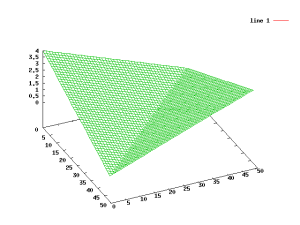
To see the orientation even better, I chose
imagesc(abs(xx+yy))
imagesc(abs(xx+2*yy))
imagesc(abs(-xx+4*yy))
corresponding to the further vectors and
. This is what I get:

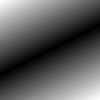

The turning around of that plane now corresponds to the behavior of the mentioned inner product function on . (Beware that the absolute values used in the plots hide the asymmetry of the inner product function!) The values are always real and go into the exponent of the exponential function.
then “rotates fastest” as
runs along to a fixed
, and is constant = 1 if it runs orthogonally; Beware that there’s a difference whether it is constant = 1 or if it reaches that value again and again. So, in the integral of the FT, the exponential function simply covers all frequencies via exhausting all values of
, and the FT is then a function in
, which takes out a single orientation of those frequencies; As already mentioned some time ago, the term “frequency” isn’t useful anymore in higher dimensions. For two-dimensional signals, i.e. images, a “frequency” can be interpreted as a pattern of lines: The narrower the pattern, the higher the frequency is. The difference to one-dimensional signals is, that those frequencies may now have an angle. It is not enough to just look at a single frequency of that line-pattern, but also to all their orientations! Only with using all orientations of patterns, an image can be analyzed according to the contained frequencies. The 2D-FT of an image therefore tells you what patterns occur in what orientation. To be more precise, you select the frequency by the length
and the orientation by its angle
, because the inner product as a function in
grows faster with growing length of
. For me, this is now a milestone in understanding the 2D-FT.
Calendar

|
September '26 |

|
||||
| Mon | Tue | Wed | Thu | Fri | Sat | Sun |
| 1 | 2 | 3 | 4 | 5 | 6 | |
| 7 | 8 | 9 | 10 | 11 | 12 | 13 |
| 14 | 15 | 16 | 17 | 18 | 19 | 20 |
| 21 | 22 | 23 | 24 | 25 | 26 | 27 |
| 28 | 29 | 30 | ||||
Quicksearch
Archives
Categories

Show tagged entries
Follow me





