Wednesday, April 4. 2007
Images to vectors: Quick index matrix


Tuesday, April 3. 2007
Images to vectors and back
Regarding the previous questions I noticed that GA on LCA groups is too general for my concerns and that the study of GA on finite abelian groups is enough.
In a certain paper HGFei published a result that for p×q-images where p and q are relatively prime there is an isomorphism to a vector of length N=pq. The theory considers the groups and
where
. One explicit mapping from the matrix indices
to the corresponding vector indices is given by
Just for a first test I set α=p and β=q and define a primitive mapping function. (I’ll have to find a quicker transform, as in my tests the switching takes too long. But this could be due to the actually large test image. In addition, I currently only manage to do the backward step by storing the indices in an index matrix.)
I have to return N instead of 0 to have a correct index value. Although the mapping is actually an isomorphism I didn’t know how to go back to the tuple (j,k), so I store the indices in an index matrix while building the image vector:
58 seconds!?  However, the image looks like this as a vector:
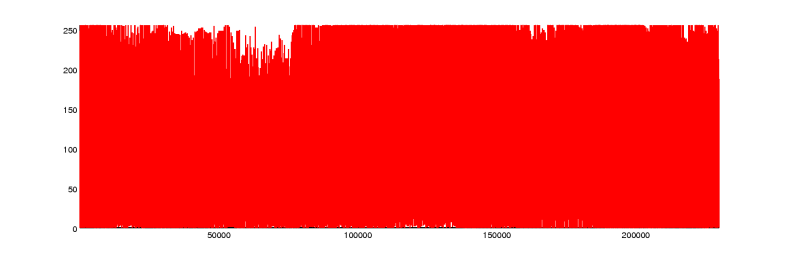
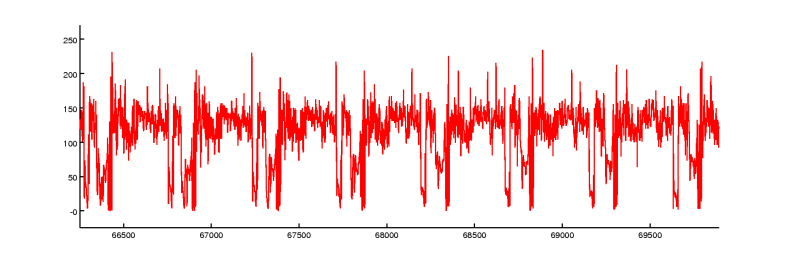
Continue reading "Images to vectors and back"
Friday, March 30. 2007
Haft, II

Die Köchin befindet sich in Schmackhaft.
Der Konditor befindet sich in Nahrhaft.
Der Forscher befindet sich in Rätselhaft.
Der Skeptiker befindet sich in Zweifelhaft.
Das kleine Mädchen befindet sich in Schreckhaft.
Thursday, March 29. 2007
Oh no! The eighties are back!

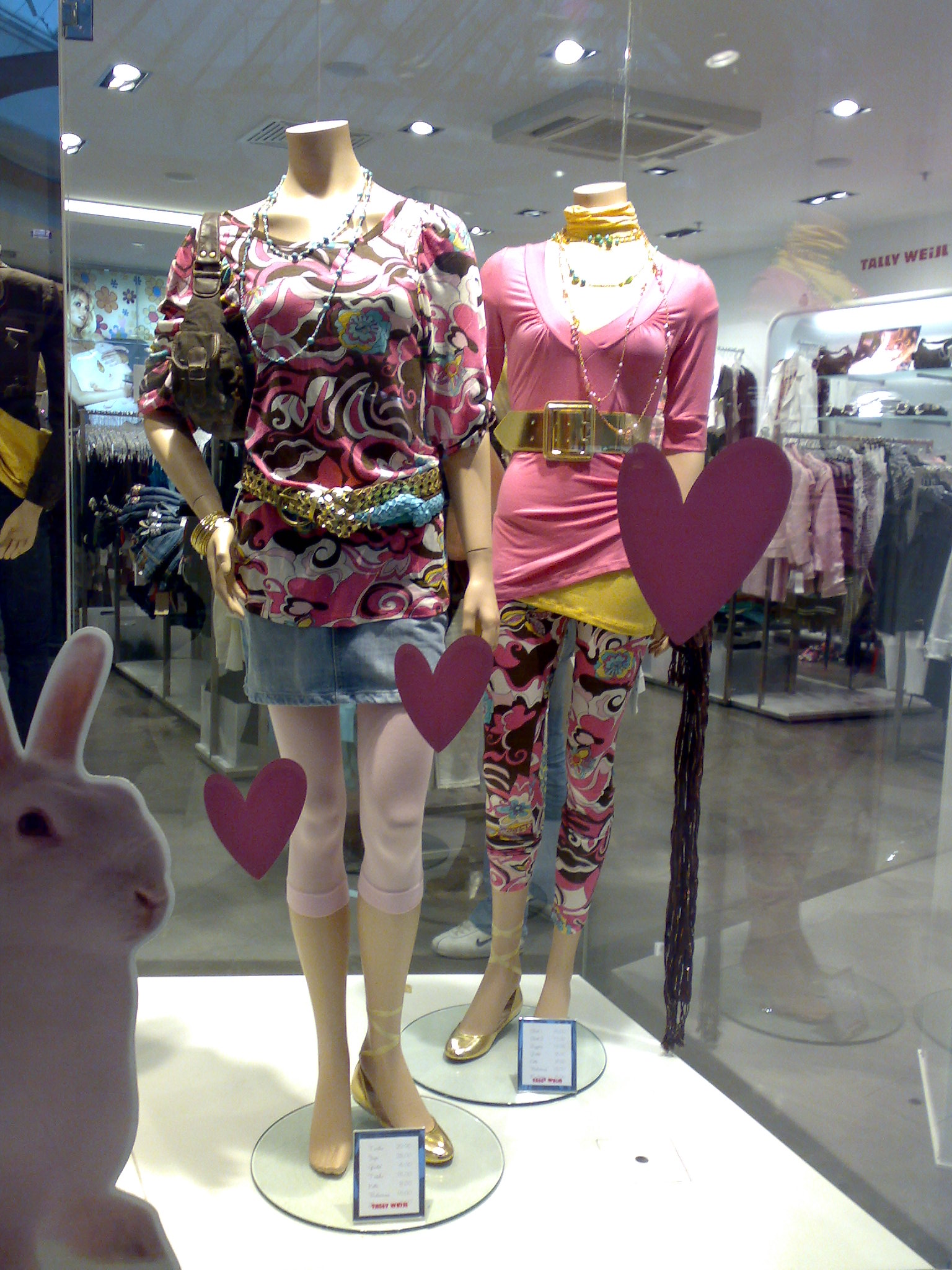 We had the fashion of the sixties and the seventies coming back. After that, everyone was already fearfully awaiting the comeback of the eighties. And here we are! Doris always says that this comeback can only be intended for people who were too young in the eighties and therefore had no chance yet to feel the terrifying clothing style of that time on their own skin.
Tuesday, March 27. 2007
Raising questions, 70-73
- What are compact groups? What are locally compact groups? What is a compactly generated group? What is an open compact subgroup?
As an example,seems to be a compact group whenever A is real-valued invertible d×d. d=1 makes
and
a compact group.
- What is a discrete (sub-)group? Why is the dual of a compact group discrete?
- Why is
for
and a real-valued invertible d×d-matrix A?
Maybe becausefor invertible square matrices and
, and clearly
.
- How can I implement the tensor product of separable lattices to get non-separable lattices like the quincunx lattice or a hexagonal lattice?
Sunday, March 18. 2007
Schwarzfahren kann sich unmöglich auszahlen
Thursday, March 15. 2007
Convolving a zebra with modulated Gaussians
I finally managed to scale the reconstructed images appropriately such that one can see at what locations certain 2D-frequencies occur. I FT’ed an image of a zebra and “windowed” the FT with a shifted Gaussian. Doing the inverse FT of that cutout yields a convolution of the input image with a modulated Gaussian, corresponding to
This is the zebra, a 480×480 pixel sample I clipped from an image I found in the Wikimedia Commons, and its FFT2:
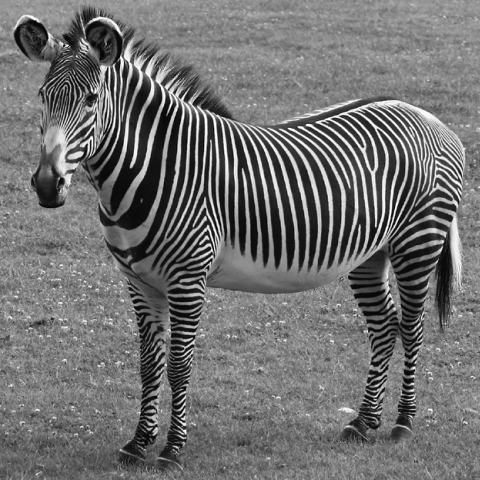
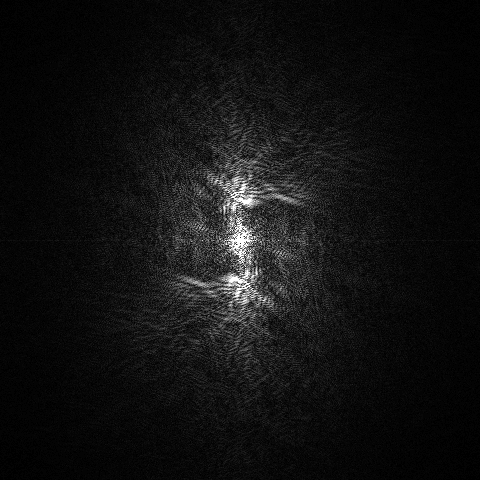
Again, I rotated the image of the FT by 90° to match the orientation of the “jets” with the line patterns in the zebra. Clearly, the vertically oriented frequencies dominate the image. Now I window the FT-image by placing a Gaussian at the origin. This results in a low-pass filter. The IFT gives a reconstructed image which only contains the lowest frequencies:
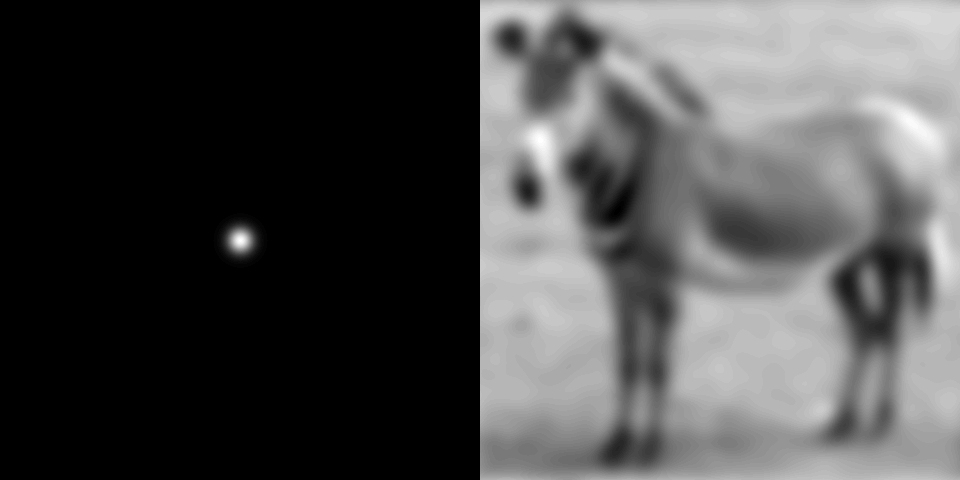
The left half shows the (unmodulated) Gaussian with which the original image has been convolved. The right half shows the reconstructed image—the animal has lost all its zebra patterns! This effect is identical to a Gaussian blur.
Continue reading "Convolving a zebra with modulated Gaussians"
Wednesday, March 14. 2007
Time-frequency shifts of a 2D-Gaussian (Addendum)
I found out that the mentioned symmetry on the FFT2-picture occurs because the modulation in the input image only has a real part and no imaginary part. If one looks at fft2(real(Mg)) where Mg is a modulated Gaussian, one really gets two symmetrically shifted Gaussians as output.
And the Gaussian in the center still comes up because the line patterns don’t span completely between -1 (black) and 1 (white).
I also found a bump2d.m in the NuHAG toolbox which incorporates gaussnk.m, so I can trash my gauss2.m-attempt.
Calendar

|
October '26 | |||||
| Mon | Tue | Wed | Thu | Fri | Sat | Sun |
| 1 | 2 | 3 | 4 | |||
| 5 | 6 | 7 | 8 | 9 | 10 | 11 |
| 12 | 13 | 14 | 15 | 16 | 17 | 18 |
| 19 | 20 | 21 | 22 | 23 | 24 | 25 |
| 26 | 27 | 28 | 29 | 30 | 31 | |
Quicksearch
Categories

Show tagged entries
Follow me





