Friday, February 25. 2011
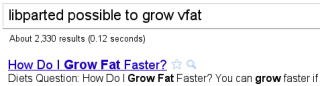
Syncing with rsync to FAT devices

(I started this as a draft two years ago, but wasn’t sure about its correctness then.)
Usually, one uses the -a switch when archiving files with rsync from Unix to Unix. -a is an abbreviation for -rlptgoD, which means
- -r: recurse into directories,
- -l: copy symlinks as symlinks,
- -p: preserve permissions,
- -t: preserve modification times,
- -g: preserve group (ownership),
- -o: preserve owner,
- -D: preserve device and special files,
but this doesn’t make sense if the target is an MS FAT device (such as a USB key) or a CIFS/SMB/Samba host, as that old file system cr4p doesn’t know anything about symbolic links, file permissions, ownerships or other Unixy properties. Thus, rsync fails to match these features at all and synchronizes every single bit of every single file again.
The solution I found is to simply use the tuple of time-stamp and file size as the only criteria whether something has changed. This still results in warnings about that the time-stamps of directories couldn’t be set, but at least the sync works. An example command line could thus be
Monday, January 31. 2011
VOR-/ÖBB-Fahrpläne mit Android abrufen, III
Nach einer ersten Auflistung einiger Möglichkeiten im April 2010 und einem Follow-Up im Juni mache ich hier nun weitere aktuelle Ergänzungen und erstelle einen Überblick, zumal immer wieder Leute zu dem Thema hier „aufschlagen“ (z.B. in den Kommentaren oder per einschlägiger Websuche). Die unten angeführte Liste ist nach meiner persönlichen Präferenz gereiht, gemäß folgender Anforderungen:
- Daten aus erster Hand, d.h. möglichst keine halblegalen Apps von Drittanbietern (die z.B. einfach Webseiten parsen und deshalb irgendwann einfach nicht mehr funktionieren)
- Offline Nutzbarkeit: Speicherung von Zugverbindungsdaten zwischen 2 Stationen (Uhrzeiten, Umstiege, etc.)
- Aktuelle Zugverspätungen abrufbar
Hier nun meine Lösungen:
- SCOTTY mobil: Ja, auf Platz 1 landet bei mir die App, die es offiziell garnicht (für Android) gibt, aber per J2ME Runner betrieben werden kann. Die Liste der offiziell unterstützten Mobiltelefone liest sich wie eine Zeitreise in die Nuller Jahre. Dennoch erfüllt diese App alle oben genannten Bedingungen, auch wenn sie sich auf einem Touchscreen mit Wurstfingern eher schlecht bedienen lässt; das war ja nie vorgesehen, damals. Und die ÖBB wird wohl auch ziemlich sicher niemals einen Nachfolger präsentieren. Denn den dürfte sie offenbar in der auf Platz 3 genannten App Quando sehen. Die GPS-Ortung funktioniert übrigens nicht, wenn SCOTTY so betrieben wird.
- DB Navigator: Die Überraschung schlechthin erlebte ich mit dem Tipp für die App der Deutschen Bahn. Das ist offenbar die einzige echte Android-App, die (scheinbar wegen entsprechender Verträge) die Daten der ÖBB aus erster Hand gewinnt. Sie erfüllt alle oben genannten Bedingungen. Damit kann man zwar sogar Zugtickets kaufen, glaube aber kaum, dass die dann auch für rein innerösterreichische Zugverbindungen gültig sind.
- Quando hatte ich bereits zu einem Zeitpunkt erwähnt, als es noch keine Android-Version davon gab; diese kam Anfang September nach. Sie erfüllt immerhin die erste Bedingung, handelt es sich doch um die offizielle App des VOR, dessen Netz allerdings nur den Osten Österreichs (um Wien) abdeckt. Sie war anfangs so schlecht benutzbar, dass sie sich bei vielen Nutzern dauerhaft disqualifiziert hat. Im Market findet man auch unzählige Protestbewertungen, die die ÖBB dazu ermuntern sollen, ihre Daten doch für Google Maps frei verfügbar zu machen – der zweite Faktor, bei dem die Österreicher den Deutschen nicht nachkommen. Ansonsten ist es für Abfahrtstafeln und GPS-Ortung ganz gut nutzbar. Verspätungen sind keine abrufbar.
- Öffi: Hier beginnen wir nun mit den Drittanbietern. Diese App hat sich dadurch bei mir hervorgetan, dass der Entwickler sehr viele, ja fast täglich inkrementelle Updates zur Verfügung stellt, die immer wieder nachbessern bzw. immer weitere Gebiete Europas abdecken. Die grafische Umsetzung von Abfahrtstafeln ist gelungen, auch gibt es eine GPS-Ortung, allerdings keine Verspätungsdaten (und wohl auch keine „Realdaten“, sondern nur den Plan – Zugausfälle z.B. wären nicht sichtbar!).
- FahrplanAT/TimetableAT: Hatte ich schon erwähnt, parst offenbar Webseiten und funktioniert nicht immer. Keine Verspätungsdaten.
- Abfahrtsmonitor: Diesen Tipp bekam ich direkt vom Entwickler. Auch er beklagt die Abwesenheit eines APIs von den ÖBB und muss selbst Webseiten parsen. Ein Test dieser noch sehr jungen App steht meinerseits noch aus.
- Fahrplan Österreich: Kenne ich nicht, hat hässliche Werbeeinblendungen und schlechte Kritiken, werde ich auch nicht testen.
- Webbrowser: Damit auch dieser erwähnt ist. Immerhin erfüllt diese Variante die Bedingungen 1 und 3.
Zum Schluss sei noch auf eine Speziallösung hingewiesen: Offizielle RSS-Feeds über Betriebsstörungen. Ja, diese Feeds gibt es, und sie sind gut versteckt, aber via ÖBB-Streckeninformation zu finden. Sie würden sich gut z.B. in einem RSS-Widget machen.
[Update 01.02.] Ein Twitter-User hat mich darauf aufmerksam gemacht, dass es offenbar im 2. Quartal eine Android-App von den ÖBB geben soll. Dies geht aus einem Kommentar auf der Facebook-Seite der ÖBB vom 5. Jänner hervor.
Thursday, January 20. 2011
Aftermath in the truest sense, II

One year ago I wrote about that I was authoring a chapter for a book about mathematical imaging together with O. Christensen and H. Feichtinger. Some months ago our contribution was accepted as Chapter 29 (“Gabor Analysis for Imaging”) of Springer’s “Handbook of Mathematical Methods in Imaging” (ISBN 978-0-387-92920-0). The book is available for online access since last week for ~€600. As it has got 1607 pages, it will take me some time to read through it.
As mentioned previously, our content mainly resembles the structure of my Master’s thesis from 2007, but with more mathematical rigor thanks to the two mentioned authors. Originally I wanted to recreate the pictures I had shown in my thesis, but decided to just reuse them.
Thursday, December 16. 2010
MTA configuration FAIL
Monday, November 1. 2010
How I'd like to use Twitter
(The following is a kind of current-state analysis, maybe leading to my long intended anti-WWW rant.  It might become more interesting in a few years.)
Honestly, I think Twitter is a broken technology. 140 characters are way too few to provide useful context. And as URLs eat from this character pool, the urge for link shorteners simply leaves this service behind broken, IMHO. Just look at this plot of the distribution of tweet lenghts:

Well, some misuse Twitter as a chat, although IRC would be the technology of choice for that. I mainly use it as a news stream. In fact, Twitter changed their orientation from individual “Took a dump, ate a banana” status updates to personalized news. Although RSS or Atom are dedicated technology for collecting headlines and articles (and keeping their read/unread state), Twitter provides a unified time flow (that passes by, no matter if you read it or not). And while RSS/Atom is a kind of pull technology (i.e. you have to look at different feeds and articles for yourself), Twitter is a push variant where all elements meld into a single data stream.
The problem is, in engineering terms, there’s so much noise in the data; there’s so much irrelevancy occurring in the timeline, at least in mine. I followed more and more people, like “Hey, this guy developped that app, and there’s a link to his Twitter”, or I chose to follow various companies when I noticed they had an account at Twitter. But more and more often I asked myself where a certain guy/gal I followed actually came from.
I’m wasting too much time at Twitter. Meanwhile, I’m following more than 250 people. (Yeah, I think those who follow >300 are simply nuts. How the hell do they handle their timeline? How can they claim Twitter is not a distraction?)
Me wants:
- More than 140 characters please. 200 or so should be OK. Or, better, do it like Google Buzz or Facebook and just collapse longer posts.
- Attach personal notes to provide the context about who this Twitter user is or why it was interesting to follow him/her. Their own bios are often useless.
- Some sort of global maximum tweet rate to allow skipping of irrelevant tweets
- Give weights to followers: “Important” followers should always be in the timeline, while tweets from others are allowed to be skipped if there are too many tweets; also, some followers might be muted, but not unfollowed (i.e. some kind of bookmarking).
- There should also be a rate per user. If one suddenly starts to reproduce audio content from e.g. a conference talk, I shouldn’t be bugged, please.
- The decision about relevance should be made similar to the My6Sense client. This innovative client aggregates from one’s Twitter, Facebook, Google Buzz and Google Reader subscriptions and automatically learns the topics that are most interesting for the individual.
- This automatic learning should be done using the read messages/articles (like My6Sense does) and/or by buttons in a “plus”/“minus” manner to prevent “accidentally” read articles from becoming relevant.
- URLs should not eat from the character pool and be placed in some kind of footnotes. Or, rather, make them the usual linked words.
Of course, a lot of this already sounds like RSS. But there are tweets that are status updates per se and don’t contain URLs.
It appears to me that Twitter and RSS (and maybe the whole social *BUZZWORD ALERT* media) are becoming “the HTTP of a new WWW”: It’s up to new and upcoming user interfaces to aggregate, weight, filter, sort and manage content coming from various data streams; new user interfaces for new devices, but also for the “old scholars”. I noticed recently that things are becoming better for me when using different Twitter—or rather, aggregator—clients, like TweetDeck or My6Sense. It’s becoming important for me to not just scream or hear screams, but to consume and provide relevant information.
Thursday, October 21. 2010
Why I rooted my phone
This is just a note for myself what hacks I applied to my phone to make it more usable to me. This is to reproduce these settings once I flash the full Android 2.2 “FroYo” image onto my Motorola Milestone:
- AdFree Android to hide ads in nearly all apps. This is done by installing a /system/etc/hosts file with ad-servers’ IPs pointing to localhost.
- Memory hack: Dalvik-cache is moved from the /data to the /cache partition to free up some space.*†
- Apps2sd: The whole /data/app[-private] directories are placed on the SD card to free up even more space.†
- Overclocking and o/c profiles: The Milestone/Droid’s factory setting is the 600 MHz CPU downclocked to 550 MHz, however, I run it on 800 MHz, but only when the display is on.
[Update Oct 31] I almost forgot to mention the CPUfreq interactive governor, which I installed in addition. - JIT compiler backport to make all apps faster.*†
- QUERTY keyboard layout despite the German/European QUERTZ key arrangement.*
- Have WaveSecure as system app to be able to localize it via GPS remotely anytime.†
- Make screenshots using drocap2.
- Autostarts to avoid starting too many apps at boot time.
- Hot Reboot for quick UI restarts instead of lame cold reboots.
- Uninstall/reinstall some system apps such as the default browser or XING; this is a work-around for the “Package file is invalid” error messages in the Market.
- Some tweaks of the build.prop to avoid hiding some apps in the Market*, plus more window events per second.
- Busybox to get a full GNU/Linux command line environment with bash, grep & Co.*
- [Update Oct 27] Replace the YouTube app by the new and backported version†
- [Update Nov 9] A hack to display the battery level in 10%-steps instead of 20%.
* Achieved by TimeTurn’s OpenRecovery for Milestone
† Not needed anymore in 2.2
And while we’re at it: Of course the Android system has got some flaws, but I think the situation’s similar to desktop environments: The on-board software is able to provide some basic things, but it’s up to third party developers to provide apps with full functionality, especially when I think of features regarding contacts (e.g. edit groups and birthdays, share via Bluetooth or SMS), calendar (e.g. search) or e-mail (e.g. search). Further apps I have installed are on this always almost complete and up-to-date list—HTH:
Continue reading "Why I rooted my phone"

Calendar

|
September '26 |

|
||||
| Mon | Tue | Wed | Thu | Fri | Sat | Sun |
| 1 | 2 | 3 | 4 | 5 | 6 | |
| 7 | 8 | 9 | 10 | 11 | 12 | 13 |
| 14 | 15 | 16 | 17 | 18 | 19 | 20 |
| 21 | 22 | 23 | 24 | 25 | 26 | 27 |
| 28 | 29 | 30 | ||||
Quicksearch
Archives
Categories

Show tagged entries
Follow me





