Saturday, July 11. 2009
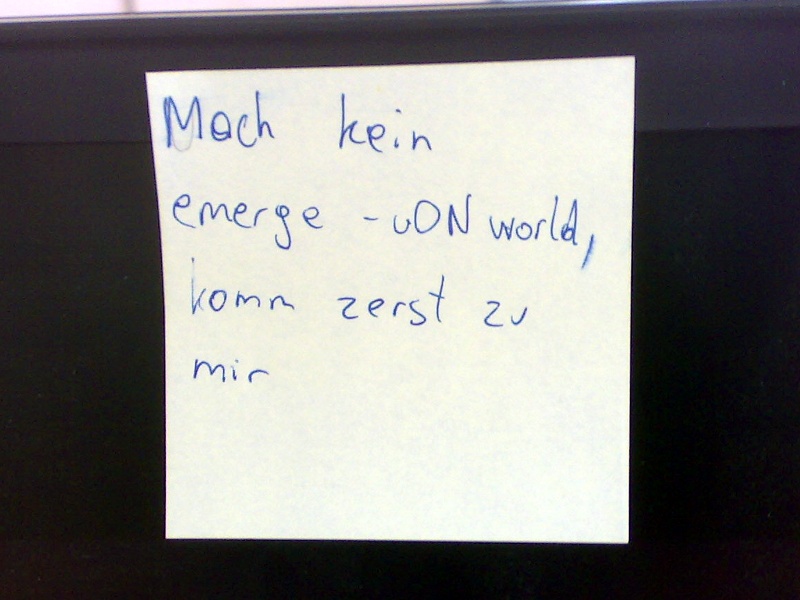
Windows fundies always knew it!

Tuesday, June 30. 2009
Kerze, du musst verschwinden

1983_kerze_du_musst_verschwinden.mp3
Kerze, du musst verschwinden
Kerze, du musst verschwinden
Du bist also da
Kerze, du musst verschwinden
Und der Rauch auch, mach ein Feuer
Jetzt ist Weihnachten
Du bist hier, du bist weg und du bist hier
Mach ein Feuer, uh!
MICHIII!!! Jetz wü i wos singa!
Plötzlich brennt das ganze Haus
Und das Fenster, und der Blumenstrauß
Alles, alles brennt doch auf
Alles ist doch alles schwarz
Schere, Blumenstock, Sessel, Kerze
Aschenbecher, Tisch, Decke, Boden
Alles, alles ist doch kaputt
Und das ganze Haus explodiert
Und der Blumenstrauß ist fort
Copyright © 1983 by Stephan Paukner
Friday, June 26. 2009
What a speed gain!, II

The Cooler Master V10 was finally available and is finally mounted on my CPU. I could thus start my overclocking experiments. My first comparisons with my old notebook already revealed some nice performance gains with the Core i7-920’s default speed of 2.67 GHz. So let’s see where a little tuning would get us. I originally only wanted to go to 3.2 GHz in the first time, but this turned out to be no challenge at all for this air cooler!
The impressively massive appearance lived up to its promise: At 3.2 GHz the CPU was still idling at 34–40 °C and didn’t exceed 62 °C at full torture (using MPrime). Then I went on to 3.5 GHz (where I had to increase voltage from 1.2 V to 1.3 V), not exceeding 65 °C. This potential was crying for more. Finally, at 3.8 GHz I didn’t exceed 74 °C, and this is where I’ll stay for now, idling at 38–43 °C with silent 900 rpm. I could probably go to 4.0 GHz; my RAM can bear 1600 MHz, what is the BCLK (base clock)’s speed of 200 MHz ×8.
So, how does this compare to the default 2.67 GHz? I chose the same image processing tasks as before:
Task #1: Render 8 RAW images to PPM in parallel
2.6 GHz: 04.6 sec → 22× faster
3.2 GHz: (No difference measurable)
3.8 GHz: 03.6 sec → 28× faster
Task #2: Render 8 RAW images to JPEG in parallel
2.6 GHz: 18.2 sec → 16.5× faster
3.2 GHz: 16.0 sec → 18.8× faster
3.8 GHz: 13.7 sec → 21.9× faster
Now I should do some benchmarking of my GPU. What’s the most demanding 3D shooter under Linux? 

Tuesday, June 23. 2009
Discount FAIL

 Negative discount (“Rabatt”) means extra charge. They don’t fool me!
Wednesday, May 6. 2009
Documentation FAIL
From `man rkhunter`:
TESTS
      additional_rkts
             This  test  is for SHORT_EXPLANATION. It works as part of GROUP.
             Corresponding configuration file entries: ONE=one,  TWO=two  and
             for white-listing THREE=three,three. [...]
Thursday, April 30. 2009
XFS file system defragmentation
File system defragmentation is a not as obvious task in Linux/Unix as it is in Windows. Modern Unix file systems are designed to avoid fragmentation. However, in rare cases I explicitly want to defrag my favored XFS partitions, and it’s done this way:
Check fragmentation percentage:
Defrag:
Calendar

|
October '26 | |||||
| Mon | Tue | Wed | Thu | Fri | Sat | Sun |
| 1 | 2 | 3 | 4 | |||
| 5 | 6 | 7 | 8 | 9 | 10 | 11 |
| 12 | 13 | 14 | 15 | 16 | 17 | 18 |
| 19 | 20 | 21 | 22 | 23 | 24 | 25 |
| 26 | 27 | 28 | 29 | 30 | 31 | |
Quicksearch
Categories

Show tagged entries
Follow me





